Sigalit Landau
Sigalit Landau (b. 1969, Jerusalem) is one of Israel’s most internationally recognized contemporary artists. A graduate of the Bezalel Academy of Arts and Design, she works across sculpture, installation, video, photography, and performance, using the body and everyday materials to address conflict, migration, vulnerability, and survival.
Landau’s practice often transforms ordinary objects into emotionally and politically charged symbols. Her landmark 2002 installation The Country in which Rake was originally exhibited responded to the violence of the Second Intifada through imagery connected to the body, agriculture, nourishment, and decay. She is especially celebrated for her ongoing Dead Sea project, submerging objects in its mineral-rich waters until salt crystals transform them into haunting, otherworldly sculptures.
Landau participated in documenta X in 1997 and represented Israel at the Venice Biennale in 1997 and 2011. She has presented major exhibitions at the Museum of Modern Art, New York; Tel Aviv Museum of Art; Israel Museum, Jerusalem; MACBA, Barcelona; and Museum der Moderne Salzburg. Her work is held in the collections of MoMA, Centre Pompidou, the Hirshhorn Museum, and leading Israeli museums.
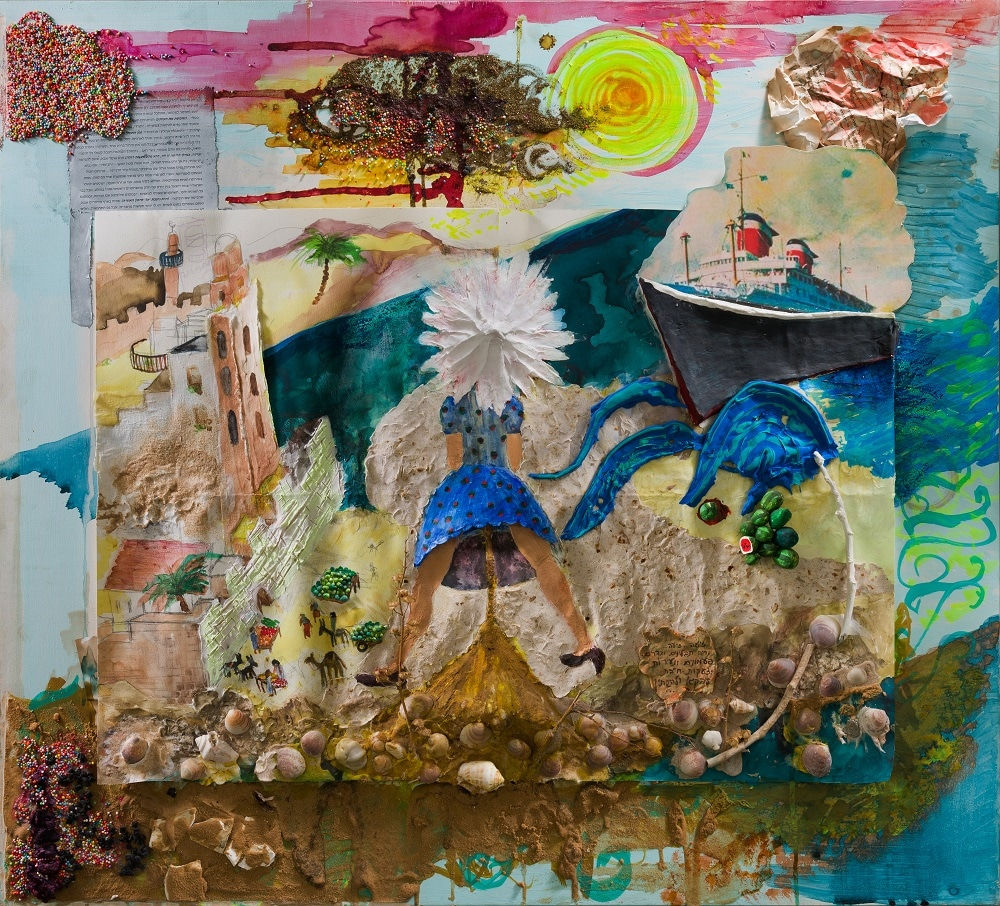
Unstaged / A Play Not Played is a series of seven figurative wall reliefs created over the past two years by Landau in collaboration with writer and dramatist Oren Neeman. Incorporating a range of materials, from sand, clay and fabric to paper cutouts, organic materials and found objects, the dramatic cycle depicts scenes inspired for the most part by the life stories of two women from very different periods in history, the daughter of Jephthah (unnamed in the biblical story) and legendary Habima actress Hanna Rovina. Like the tragic biblical figure, who fell victim to her father’s fateful vow, so was Rovina – who played the former in her first theatrical appearance as an amateur – forced to endure a father’s forsaking: her father, upon learning of Rovina’s theatrical aspirations, disowned her and never came to see her on stage, despite the huge acclaim she garnered.
Direct and frontal in their compositions, the collaged reliefs of Unstaged show visceral scenes partly based on the biblical text and partly Rovina’s life and partly invented: the binding of Jephthah’s daughter, Rovina’s famed performance in The Dybbuk and the trials in her life, as well as themes drawn from the artist’s own personal life. Two of the relief on view reference noted Israeli artists from Rovina’s time, Reuven Rubin and Mark Chagall. Set in large window-like frames, like a set of miniature installations hung on the gallery walls, the series showcases to the viewer these exposed narratives of fury, defiance, disillusionment and regret.
Provenance
Tiroche DeLeon CollectionHezi Cohen Gallery, Tel Aviv, Israel